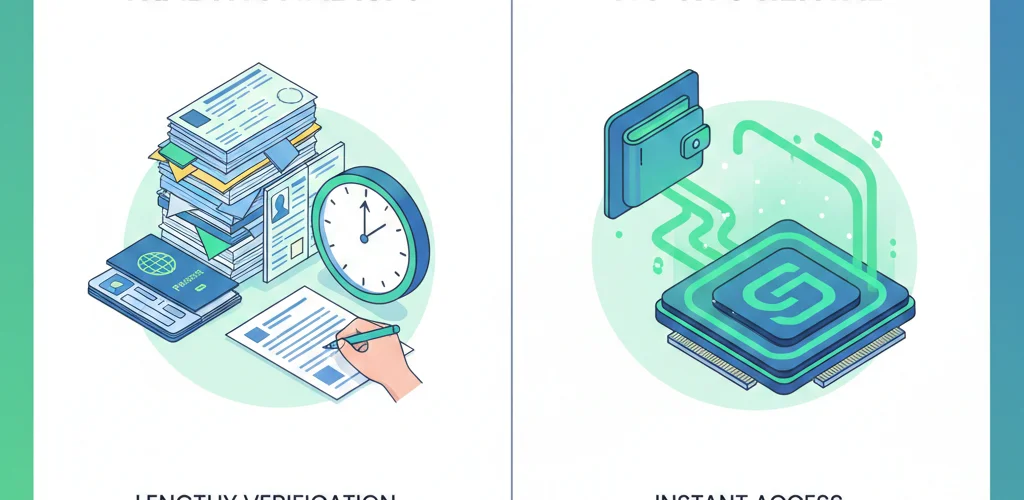
Renting a GPU from AWS requires a credit card, phone number, address verification, and sometimes a government ID. Azure wants a Microsoft account tied to a verified identity. Google Cloud runs credit checks. For a developer who needs four hours of A100 time to fine-tune a model, these requirements represent barriers that have nothing to do with technical capability or willingness to pay.
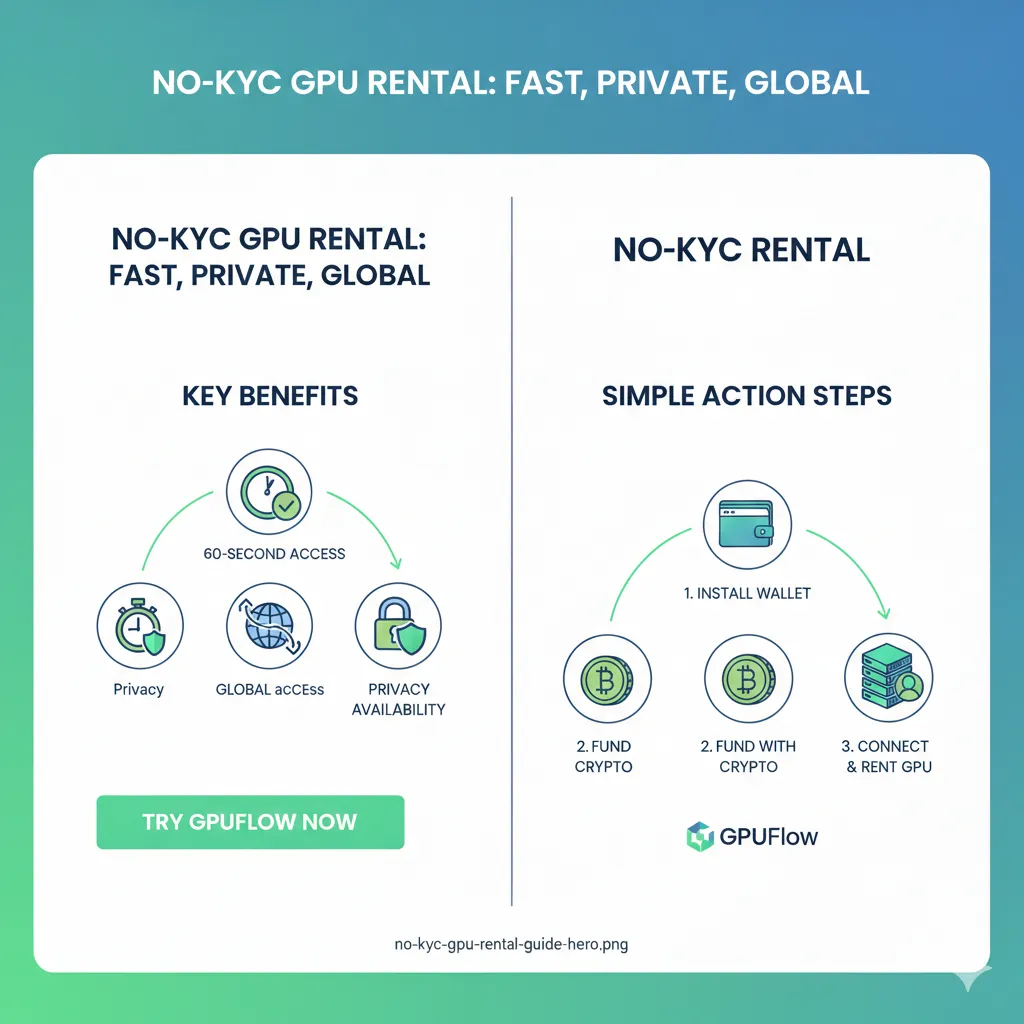
No-KYC GPU rental platforms eliminate identity verification from the process entirely. You connect a cryptocurrency wallet, deposit funds, and access hardware. The entire onboarding takes under sixty seconds. This guide examines which platforms operate without KYC requirements, what practical tradeoffs exist, and how to evaluate whether a no-verification platform deserves your trust and your money.
For a complete walkthrough of cryptocurrency payments including wallet setup, smart contract escrow mechanics, and platform comparisons, see our Complete Guide to Renting GPUs with Cryptocurrency.
Why GPU Rental Platforms Require KYC (And Why Some Don’t)
KYC—Know Your Customer—refers to identity verification processes that financial institutions use to comply with anti-money laundering (AML) regulations. Understanding why KYC exists clarifies when it’s actually necessary and when it’s simply inherited from payment infrastructure.
The Regulatory Chain
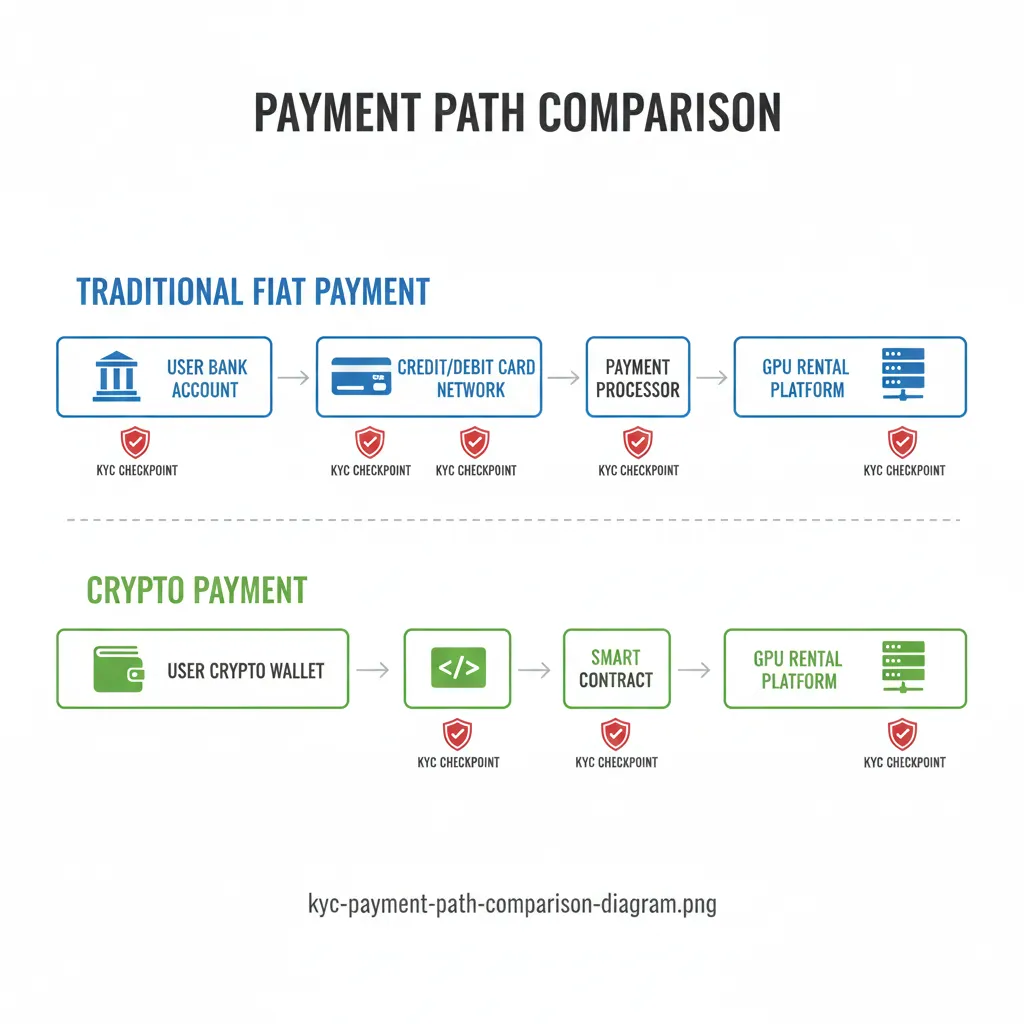
When you pay for GPU rental with a credit card, your transaction passes through regulated financial infrastructure:
1. Your bank (card issuer):
- Regulated entity with KYC obligations
- Must verify customer identity
- Reports suspicious transactions to authorities
2. Card network (Visa/Mastercard):
- Operates under banking regulations
- Requires merchants to maintain compliance
- Can freeze merchant accounts for violations
3. Payment processor (Stripe, PayPal):
- Licensed money transmitter in most jurisdictions
- Must verify merchant identity
- Passes verification requirements to platforms
4. GPU rental platform:
- Uses payment processor → inherits their requirements
- Must maintain records for compliance
- Verifies user identity to satisfy upstream requirements
The chain creates inherited obligations. A GPU rental platform using Stripe must collect user identity because Stripe requires it, because Visa requires it, because banking regulators require it.
Breaking the Chain with Cryptocurrency
Cryptocurrency-native platforms break this regulatory chain by avoiding traditional payment infrastructure entirely:
Cryptocurrency payment flow:
- You hold cryptocurrency in self-custodied wallet
- Smart contract locks funds as escrow
- GPU provider delivers service
- Smart contract releases payment to provider
No regulated financial intermediaries involved. The platform facilitates peer-to-peer transactions without holding customer funds in traditional banking systems.
This is why GPUFlow requires no KYC:
- No credit card processing (no banking regulations)
- No fiat currency handling (no money transmission license needed)
- Smart contract escrow (no platform custody of funds)
- Cryptocurrency-to-cryptocurrency transactions (outside traditional finance scope)
The Jurisdiction Factor
Platform location and legal structure also determine KYC requirements:
US-based platforms (RunPod, Lambda Labs):
- Subject to US banking regulations
- FinCEN money transmission rules may apply
- State-by-state licensing requirements
- Generally require KYC for full functionality
EU-based platforms:
- Subject to AMLD (Anti-Money Laundering Directive)
- MiCA regulations for crypto services
- Generally require KYC above certain thresholds
Offshore or decentralized platforms:
- May operate outside major regulatory jurisdictions
- Smart contract-based operations reduce regulatory touchpoints
- KYC requirements minimal or absent
GPUFlow’s approach:
- Cryptocurrency-native architecture
- Smart contract escrow (not platform custody)
- No fiat currency handling
- Result: No KYC required
KYC Is About Payment, Not GPUs
Critical insight: KYC requirements attach to payment processing, not GPU rental.
There is no regulation requiring identity verification to rent compute resources. The verification exists because:
- Credit card companies require it
- Banks require it
- Payment processors require it
- Platforms inherit these requirements
Remove traditional payment infrastructure → remove KYC requirements.
This is why the same GPU hardware can require full identity verification on one platform (RunPod with credit card) and zero verification on another (GPUFlow with cryptocurrency). The compute resource is identical; the payment infrastructure differs.
No-KYC GPU Platforms Compared
Not all GPU rental platforms are equal in their approach to identity verification. This section examines the major options, their actual requirements, and what “no KYC” means in practice for each.
GPUFlow: True No-KYC
Verification required: None
What you need:
- Cryptocurrency wallet (MetaMask, Phantom, etc.)
- Cryptocurrency balance (ETH, MATIC, USDC, SOL)
- Nothing else
What you don’t need:
- Email address
- Phone number
- Government ID
- Selfie or photo verification
- Address verification
- Credit card
How it works:
- Visit GPUFlow.app
- Click “Connect Wallet”
- Approve wallet connection (does not grant fund access)
- Deposit cryptocurrency
- Select GPU and start rental
- Total time: Under 60 seconds
Why no KYC is possible:
GPUFlow operates entirely on cryptocurrency rails:
- Smart contract escrow holds funds (not platform bank account)
- Payments are wallet-to-wallet via blockchain
- No fiat currency touches the platform
- No regulated payment processors involved
Platform fees: 10-15%
Typical GPU pricing:
| GPU | Hourly Rate |
|---|---|
| RTX 4090 | $0.50-0.80 |
| RTX 3090 | $0.35-0.55 |
| A100 40GB | $1.20-1.80 |
| A100 80GB | $1.60-2.40 |
Escrow protection:
Your payment locks in a smart contract viewable on-chain. Neither GPUFlow nor the GPU provider can access these funds until rental conditions are met. This provides cryptographic guarantees stronger than trusting a KYC-verified platform to hold your money honestly.
For detailed explanation of how smart contract escrow protects your payment and eliminates counterparty risk, see our Complete Guide to Renting GPUs with Cryptocurrency.
Best for:
- Maximum privacy
- Fastest possible onboarding
- Users in regions with limited banking access
- Developers avoiding corporate account requirements
Vast.ai: No KYC for Renters
Verification required: None for renting, KYC for provider payouts
What you need:
- Email address
- Payment method (crypto or credit card)
What you don’t need:
- Government ID (for rental)
- Phone verification
- Address verification
The distinction matters:
Vast.ai separates renters from providers:
- Renters: No identity verification required
- Providers: Must complete KYC to withdraw earnings
If you’re only renting GPUs (not providing them), Vast.ai operates effectively as a no-KYC platform.
Payment options:
| Method | KYC Required? |
|---|---|
| Cryptocurrency (via CoinPayments) | No |
| Credit card | No (card company already verified you) |
| Bank transfer | No |
How cryptocurrency payment works:
- Create Vast.ai account (email only)
- Navigate to billing
- Select “Add Credit” → “Cryptocurrency”
- Choose crypto (BTC, ETH, USDC, others)
- Complete payment via CoinPayments gateway
- Credit appears after blockchain confirmation
Platform fees: ~20%
Typical GPU pricing:
| GPU | Hourly Rate |
|---|---|
| RTX 4090 | $0.29-0.78 |
| RTX 3090 | $0.20-0.45 |
| A100 40GB | $0.84-1.49 |
| A100 80GB | $1.20-2.10 |
Escrow type: Platform-held (not smart contract)
Vast.ai holds funds in their systems, not blockchain-based escrow. This requires trusting Vast.ai as a company rather than trusting cryptographic guarantees. Their track record is solid, but the trust model differs from GPUFlow.
Best for:
- Largest GPU selection
- Lowest absolute pricing
- Users comfortable with platform-held funds
- Those wanting crypto payment without full crypto-native experience
RunPod: Partial KYC
Verification required: Tiered based on usage
RunPod’s tiered approach:
| Tier | Requirements | Limits |
|---|---|---|
| Basic | Email only | Limited GPU access, low spending caps |
| Verified | Phone + email | Higher limits, more GPU options |
| Full KYC | ID verification | Unlimited access, withdrawal enabled |
What this means in practice:
- Small rentals: Email-only signup works
- Regular usage: Phone verification likely required
- Withdrawals: Full KYC required (relevant if you’re also a provider)
Cryptocurrency payment:
RunPod accepts crypto via Coinbase Commerce:
- Bitcoin (BTC)
- Ethereum (ETH)
- USDC
However, account limits may still apply based on verification tier.
Platform fees: ~20%
Typical GPU pricing:
| GPU | Hourly Rate |
|---|---|
| RTX 4090 | $0.44-0.74 |
| RTX 3090 | $0.22-0.44 |
| A100 40GB | $1.09-1.89 |
| A100 80GB | $1.69-2.29 |
Best for:
- Users wanting managed experience with templates
- Those comfortable with partial verification
- Developers prioritizing reliability over privacy
Direct Provider Arrangements: Variable KYC
Verification required: Provider-dependent
Outside major platforms, individual GPU providers sometimes accept direct payment:
Where to find direct providers:
- Discord communities (ML/AI servers)
- Reddit (r/MachineLearning, r/LocalLLaMA)
- Telegram groups
- Provider’s own websites
Typical arrangement:
- Negotiate directly with provider
- Pay cryptocurrency to provider’s wallet
- Receive SSH credentials
- No platform involvement
KYC status: Usually none (individual-to-individual transaction)
Risks:
- No escrow protection
- No platform dispute resolution
- Must evaluate provider trustworthiness yourself
- No refunds if service fails
Risk mitigation:
- Start with small test rentals
- Check provider reputation in communities
- Use escrow services (Particl, manual escrow via trusted third party)
- Get references from other users
Best for:
- Experienced users comfortable evaluating counterparty risk
- Maximum privacy requirements
- Negotiated pricing for large/long-term rentals
Comparison Matrix
| Platform | KYC Required | Payment Methods | Escrow Type | Platform Fee |
|---|---|---|---|---|
| GPUFlow | None | Crypto only | Smart contract | 10-15% |
| Vast.ai | None (renters) | Crypto + card | Platform-held | ~20% |
| RunPod | Tiered | Crypto + card | Platform-held | ~20% |
| Direct P2P | Usually none | Crypto | None (or manual) | 0% |
Decision framework:
Want maximum privacy + smart contract protection?
→ GPUFlow
Want largest selection + lowest prices?
→ Vast.ai
Want managed experience + willing to verify phone?
→ RunPod
Want zero fees + comfortable with risk?
→ Direct P2P

---
## What You Give Up Without KYC: Tradeoffs and Limitations
No-KYC GPU rental offers clear advantages—speed, privacy, global accessibility. But tradeoffs exist. Understanding these limitations helps you decide whether no-KYC platforms suit your specific situation.
### Tradeoff 1: Cryptocurrency-Only Payment
**The limitation:**
No-KYC platforms accept cryptocurrency because cryptocurrency enables no-KYC operation. This is not a design choice—it's a structural requirement. Traditional payment methods (credit cards, bank transfers) carry KYC obligations from the financial system.
**What this means:**
- You must acquire cryptocurrency before renting
- Learning curve if you've never used crypto
- Additional step compared to entering credit card number
- Exchange fees when purchasing crypto (0.1-1%)
**Who this affects most:**
- Users with no cryptocurrency experience
- Those in jurisdictions with restricted crypto access
- Users wanting to expense GPU rental to corporate credit card
- Anyone needing instant access without any setup
**Who this affects least:**
- Developers already holding cryptocurrency
- Users in high-fee countries (crypto saves money regardless)
- Privacy-conscious users (willing to learn for privacy benefit)
- Anyone who has used MetaMask or similar wallets
**Mitigation:**
The cryptocurrency learning curve is approximately 30-60 minutes. Our [Complete Guide to Renting GPUs with Cryptocurrency](/en/rent-gpu-with-crypto/) covers wallet setup, stablecoin acquisition, and first-rental walkthrough in detail. Once established, the workflow is comparable to any payment method.
---
### Tradeoff 2: No Account Recovery
**The limitation:**
Traditional platforms tie accounts to verified identities. Forgot your password? Reset via email. Lost email access? Verify identity with phone. Lost phone? Provide government ID.
No-KYC platforms cannot offer these recovery paths because they don't know who you are.
**What this means:**
- Lose wallet access → lose any funds deposited on platform
- No "forgot password" recovery for wallet-based authentication
- Seed phrase is sole recovery mechanism
- Platform support cannot help recover wallet access
**The risk is real:**
If you lose your MetaMask seed phrase:
- Wallet is permanently inaccessible
- Any cryptocurrency in wallet is lost forever
- Any platform credits tied to that wallet are lost
- No appeal process exists—no identity verification can recover access
**Who this affects most:**
- Users unfamiliar with cryptocurrency security practices
- Those who don't maintain secure seed phrase backups
- Anyone prone to losing passwords or access credentials
**Who this affects least:**
- Users experienced with cryptocurrency custody
- Those with established secure backup practices
- Anyone already using hardware wallets with proper backup
**Mitigation:**
1. Write seed phrase on paper (never digital)
2. Store in secure location (safe, safety deposit box)
3. Never photograph or store in cloud services
4. Never enter seed phrase on any website
5. Consider multiple backup locations for redundancy
6. Test recovery process before depositing significant funds
**Perspective:**
Traditional account recovery requires trusting platforms with your identity data. Self-custody requires trusting yourself with a 12-word phrase. The risk shifts from "platform might misuse my data" to "I might lose my access credentials." Neither approach is risk-free—they represent different risk profiles suited to different users.
---
### Tradeoff 3: Limited Customer Support Options
**The limitation:**
KYC platforms know who you are, which enables personalized support:
- "Hi John, I see your rental on February 15th had issues..."
- Account history lookup by support staff
- Refunds to verified payment methods
- Phone or video support with identity confirmation
No-KYC platforms see only wallet addresses:
- "Wallet 0x7a3B...4f2D reports an issue..."
- Limited account history visibility
- Refunds only to originating wallet address
- Support primarily via tickets or Discord
**What this means:**
- Support interactions are less personalized
- Complex disputes may be harder to resolve
- No phone support requiring identity verification
- Response times may be longer (smaller teams typical of crypto-native platforms)
**Who this affects most:**
- Users expecting enterprise-grade support
- Those frequently needing refunds or dispute resolution
- Anyone uncomfortable with self-service troubleshooting
**Who this affects least:**
- Technical users comfortable with documentation
- Those rarely needing support intervention
- Users who prefer async communication (tickets, Discord)
**Mitigation:**
- GPUFlow's smart contract escrow reduces support needs significantly—disputes resolve through contract logic rather than human intervention
- Document everything with screenshots and transaction hashes
- Join platform Discord for community support alongside official channels
- Test with small rentals before committing significant funds
---
### Tradeoff 4: Platform Selection Constraints
**The limitation:**
No-KYC requirement filters available platforms. The largest cloud providers (AWS, Azure, GCP) require extensive verification. Some specialized GPU platforms require identity for compliance reasons.
**What you cannot access without KYC:**
| Platform | KYC Required | Why |
| ------------ | ------------ | ---------------------------------- |
| AWS | Yes | Banking and payment compliance |
| Azure | Yes | Microsoft account verification |
| Google Cloud | Yes | Credit checks, payment compliance |
| Lambda Labs | Yes | US financial regulations |
| CoreWeave | Yes | Enterprise compliance requirements |
**What you can access without KYC:**
| Platform | KYC Required | Notes |
| ---------- | ------------ | ---------------------------- |
| GPUFlow | No | Full no-KYC operation |
| Vast.ai | No (renters) | Email only required |
| RunPod | Partial | Limited without verification |
| P2P/Direct | Usually no | Provider dependent |
**What this means:**
- Cannot use hyperscaler credits or promotions requiring verified account
- Some enterprise features unavailable
- Certain GPU models may have limited availability
- Cannot consolidate with existing cloud infrastructure
**Who this affects most:**
- Enterprise users with existing cloud relationships
- Those needing specific hyperscaler integrations
- Users requiring guaranteed SLAs with legal backing
**Who this affects least:**
- Individual developers and small teams
- Users primarily needing commodity GPU access
- Those without existing cloud infrastructure dependencies
- Privacy-focused users actively avoiding hyperscalers
**Mitigation:**
For most ML and AI workloads, marketplace GPUs are functionally equivalent to hyperscaler GPUs. An RTX 4090 performs identically whether rented from AWS or GPUFlow. The silicon doesn't know or care about KYC status. Performance benchmarks confirm no difference in compute capability between platforms.
---
### Tradeoff 5: Regulatory Uncertainty
**The limitation:**
Cryptocurrency regulations are evolving globally. Platforms operating without KYC today may face future requirements. Some jurisdictions may impose restrictions on crypto-based services.
**What this means:**
- Platform policies could change with regulatory shifts
- Some jurisdictions may restrict access in future
- Long-term availability uncertain (as with any crypto service)
**Current regulatory landscape:**
| Region | Crypto GPU Rental Status |
| -------------- | ---------------------------------- |
| United States | Legal, no specific restrictions |
| European Union | Legal, MiCA implementation ongoing |
| United Kingdom | Legal, FCA oversight increasing |
| Japan | Legal, FSA regulated exchanges |
| India | Legal but taxed heavily |
| China | Restricted (crypto broadly banned) |
**Who this affects most:**
- Users in actively-restricting jurisdictions
- Those needing guaranteed long-term platform availability
- Enterprise users requiring regulatory clarity for compliance
**Who this affects least:**
- Users in crypto-friendly jurisdictions
- Those with flexible platform requirements
- Individual developers facing lower regulatory scrutiny
**Mitigation:**
- Stay informed on regulatory developments in your jurisdiction
- Maintain ability to use alternative platforms if needed
- Don't store large balances on any single platform long-term
- Consider regulatory environment when choosing primary platform
---
### Tradeoff Summary Matrix
| Tradeoff | Severity | Who It Affects Most | Mitigation Difficulty |
| ---------------------- | ---------- | ------------------------ | ------------------------- |
| Crypto-only payment | Medium | Crypto newcomers | Low (one-time learning) |
| No account recovery | High | Poor backup habits | Low (proper seed storage) |
| Limited support | Low-Medium | Support-dependent users | Medium (documentation) |
| Platform selection | Medium | Enterprise users | Low (most GPUs available) |
| Regulatory uncertainty | Low | Restricted jurisdictions | Medium (stay informed) |
**Overall assessment:**
For technically competent users comfortable with cryptocurrency basics, no-KYC tradeoffs are minimal. The primary risks (wallet loss, limited support) are manageable with proper practices. The benefits (instant access, privacy, lower fees, global availability) typically outweigh limitations for individual developers and small teams.
For enterprise users requiring SLAs, compliance documentation, and extensive support infrastructure, KYC platforms may remain appropriate despite higher friction and costs.

---
## Evaluating Platform Trustworthiness Without Regulatory Compliance Signals
KYC platforms signal trustworthiness through regulatory compliance: "We're licensed, audited, and regulated—therefore trustworthy." No-KYC platforms cannot use these signals. How do you evaluate whether a no-KYC platform deserves your trust?
### The Trust Question Reframed
Traditional trust model:
> "This platform is regulated, so they won't steal my money because regulators would punish them."
Cryptocurrency trust model:
> "This platform's smart contract makes stealing my money technically impossible, regardless of their intentions."
**The question isn't "Is this platform trustworthy?"**
**The question is "What prevents this platform from taking my funds?"**
Different answers require different evaluation approaches.
### Evaluation Criterion 1: Escrow Mechanism
**The most important factor.** How are funds protected during rental?
**Smart contract escrow (GPUFlow model):**
Your cryptocurrency locks in a smart contract when rental begins. This contract is:
- **Publicly visible:** Anyone can verify funds are locked on blockchain explorer
- **Code-enforced:** Release conditions are programmatic, not discretionary
- **Non-custodial:** Platform operators cannot access escrowed funds
- **Auditable:** Contract code can be reviewed and verified by anyone
**How to verify:**
1. Find contract address in platform documentation or transaction records
2. View contract on block explorer (Polygonscan, Etherscan)
3. Confirm your deposit transaction appears correctly
4. See funds locked in contract address, not platform-controlled wallet
**What this means:**
Even if GPUFlow's operators wanted to steal funds, the smart contract prevents it. Trust is placed in audited code, not people's honesty.
For detailed explanation of how smart contract escrow works and how to verify your funds on-chain, see our [Complete Guide to Renting GPUs with Cryptocurrency](/en/rent-gpu-with-crypto/).
**Platform-held escrow (Vast.ai model):**
Your payment goes to platform's bank account or internal ledger. Protection depends on:
- Platform's honesty and integrity
- Platform's security practices
- Platform's financial solvency
**How to evaluate platform-held escrow:**
- Company track record and longevity in market
- Public team with verifiable identities
- Community reputation over extended time
- Withdrawal reliability history from other users
**Trust hierarchy:**
Highest trust: Smart contract escrow (cryptographic guarantee) Medium trust: Established platform with multi-year track record Lower trust: New platform with unverified claims Lowest trust: Anonymous platform with no escrow mechanism
---
### Evaluation Criterion 2: Contract Audits
For smart contract platforms, independent security audits validate that code does what documentation claims.
**What to look for:**
- **Audit report publicly available:** Platform should link to full audit report
- **Reputable auditor:** Trail of Bits, OpenZeppelin, Consensys Diligence, Certik
- **Recent audit:** Code changes after audit require re-audit
- **Issues addressed:** Audit findings should be resolved with verification
**Red flags:**
- "Audit in progress" status for extended periods
- Audit by unknown or unverifiable firm
- Audit of old code version with significant changes deployed since
- No audit despite handling significant user funds
**How to verify:**
1. Find audit report on platform website or documentation
2. Verify auditor is legitimate by checking auditor's website for client list
3. Confirm audited contract address matches currently deployed contract
4. Review audit findings and documented resolutions
**If no audit exists:**
Higher risk. Smart contracts can contain bugs or intentional vulnerabilities. Without audit, you're trusting the development team's competence and honesty completely. Consider limiting exposure until audit is completed and published.
---
### Evaluation Criterion 3: Track Record and Longevity
Time is a powerful trust signal. Platforms that have operated honestly for years have demonstrated reliability that new platforms cannot claim.
**Evaluation factors:**
| Factor | What to Check |
| ------------------- | ----------------------------------------------------- |
| Operating history | How long has platform existed? |
| Transaction volume | How much value has flowed through platform? |
| Incident history | Any security breaches, fund losses, extended outages? |
| Community sentiment | What do long-term users report about experience? |
| Team continuity | Same team operating, or frequent unexplained changes? |
**Where to research:**
- **Twitter/X:** Search platform name + "scam", "problem", "issue", "lost funds"
- **Reddit:** Search relevant subreddits (r/MachineLearning, r/LocalLLaMA, r/gpumining)
- **Discord:** Join platform Discord, read message history, ask questions
- **Trustpilot/reviews:** Check for patterns while noting reviews can be manipulated
**Red flags:**
- Platform less than 6 months old with no verifiable team identity
- History of delayed withdrawals or frozen accounts
- Sudden changes in terms or policies without explanation
- Community complaints about lost funds or unresolved issues
- Team anonymous with no verifiable professional history
**Green flags:**
- 2+ years operation without major security incidents
- Responsive to community concerns and transparent about issues
- Open communication when problems occur
- Verifiable team with professional backgrounds
- Consistent policies and reliable withdrawal processing
---
### Evaluation Criterion 4: Open Source and Transparency
Platforms that operate openly are easier to trust than those operating as black boxes.
**Transparency indicators:**
| Indicator | Why It Matters |
| ---------------------------- | ------------------------------------------------------ |
| Open source contracts | Anyone can verify code does what it claims |
| Public documentation | Clear explanation of how platform operates |
| Transparent fees | No hidden charges or unclear pricing |
| Verifiable on-chain activity | Transactions visible on block explorer |
| Public team | Real people with verifiable identities and backgrounds |
**How to verify:**
1. **Smart contracts:** Is source code verified on block explorer?
2. **GitHub:** Does platform have public code repositories?
3. **Documentation:** Is platform operation clearly explained?
4. **Pricing:** Are all fees disclosed upfront before transaction?
**The transparency test:**
Ask yourself: "Could I independently verify this platform's claims without trusting their website?"
- Can I see escrowed funds on-chain? (Yes = transparent)
- Can I read and verify contract code? (Yes = transparent)
- Can I confirm platform fees from actual transaction data? (Yes = transparent)
- Can I find team members on LinkedIn or professional networks? (Yes = transparent)
---
### Evaluation Criterion 5: Community Size and Activity
Active communities provide ongoing accountability that formal regulations cannot match.
**What to evaluate:**
| Platform | Discord Members | Activity Level | Support Responsiveness |
| -------- | --------------- | ----------------- | ------------------------ |
| GPUFlow | Check current | Daily discussions | Hours to respond |
| Vast.ai | 15,000+ | Very active | Active community support |
| RunPod | 10,000+ | Very active | Official support team |
**Community evaluation process:**
1. Join Discord or Telegram community
2. Read recent messages from past week
3. Note: Are problems being reported? How are they resolved?
4. Ask a question, observe response speed and helpfulness
5. Search for complaints, observe how platform responds
**Healthy community signs:**
- Mix of support questions and general discussion
- Problems get acknowledged and resolved publicly
- Team members active and responsive to concerns
- Long-term users helping newcomers
- Critical feedback allowed (not deleted or users banned)
**Unhealthy community signs:**
- Only promotional messages, no real discussion
- Complaints deleted or critical users banned
- No team presence in community
- Questions go unanswered for days
- Only positive responses allowed
---
### Evaluation Criterion 6: Start Small
The ultimate trust test: actual behavior with real funds.
**Graduated exposure approach:**
| Phase | Amount | Purpose |
| ----------------- | ------- | ------------------------------------- |
| Test | $5-10 | Verify deposit and withdrawal works |
| Small rental | $20-30 | Complete full rental cycle |
| Normal usage | $50-100 | Typical rental amount |
| Larger commitment | $200+ | Only after multiple successful cycles |
**What to verify at each phase:**
**Test deposit:**
- Funds appear correctly in platform account
- No unexpected fees or delays
- Withdrawal to wallet works promptly
**First rental:**
- GPU access works as described
- Performance matches listed specifications
- Billing is accurate to documentation
- Rental termination works correctly
**Normal usage:**
- Consistent experience over time
- Support responsive if needed
- No degradation in service quality
**Only after multiple successful cycles should you:**
- Deposit larger amounts
- Commit to longer rental periods
- Recommend platform to others
---
### Trust Evaluation Checklist
Before depositing significant funds on any no-KYC platform:
**Smart contract platforms (GPUFlow):**
- [ ] Contract address publicly documented
- [ ] Contract source code verified on block explorer
- [ ] Security audit available from reputable firm
- [ ] Funds visibly locked in contract, not platform wallet
- [ ] Community active and generally positive
- [ ] Test deposit and withdrawal successful
**Platform-held escrow (Vast.ai, RunPod):**
- [ ] Company registered and verifiable
- [ ] 1+ year operating history without major incidents
- [ ] Team publicly identified with professional backgrounds
- [ ] Community large and active with positive sentiment
- [ ] Withdrawal reliability confirmed by community members
- [ ] Test deposit and withdrawal successful
**Direct P2P arrangements:**
- [ ] Provider has verifiable reputation in community
- [ ] References from other users available and checked
- [ ] Escrow arrangement in place (or consciously accepting total loss risk)
- [ ] Communication responsive and professional
- [ ] Small test rental successful before larger commitment

---
## Step-by-Step: From Zero to Running GPU in Under 5 Minutes
This section provides the fastest path from no account to active GPU rental. We use GPUFlow as the example because it requires the least setup—no email, no phone, no verification of any kind.
**Prerequisites:**
- Computer with modern browser (Chrome, Firefox, Brave, Edge)
- Cryptocurrency wallet with funds (setup below if needed)
- Approximately 5 minutes
### If You Already Have a Funded Wallet: 60-Second Path
**Step 1: Connect wallet (15 seconds)**
1. Visit gpuflow.app
2. Click "Connect Wallet" in top right
3. Select your wallet (MetaMask, Phantom, WalletConnect, etc.)
4. Approve connection in wallet popup
The site can now see your wallet address but cannot access funds without your approval.
**Step 2: Deposit funds (30 seconds)**
1. Click your wallet address (now shown in header)
2. Select "Deposit"
3. Choose token (USDC recommended for stability)
4. Enter amount
5. Approve transaction in wallet popup
6. Wait for blockchain confirmation (5-15 seconds on Polygon)
**Step 3: Select and rent GPU (15 seconds)**
1. Browse available GPUs or use filters
2. Click desired GPU listing
3. Click "Rent Now"
4. Confirm rental terms
5. Approve escrow transaction in wallet
6. Access credentials appear immediately
**Total time: Under 60 seconds**
You now have GPU access. The terminal or SSH credentials appear in your dashboard.
---
### If You Need to Set Up a Wallet First: 5-Minute Path
**Minute 1: Install MetaMask**
1. Visit metamask.io (verify URL carefully)
2. Click "Download" for your browser
3. Add extension to browser
4. Click MetaMask icon in browser toolbar
5. Select "Create a new wallet"
6. Create password (for local access only)
**Minute 2: Secure your seed phrase**
1. MetaMask displays 12-word seed phrase
2. **Write these words on paper in exact order**
3. Store paper in secure location
4. Never photograph, screenshot, or store digitally
5. Never enter these words on any website
6. Confirm seed phrase by selecting words in order
**This step is critical.** Lose these words = lose all funds permanently. No recovery possible.
**Minute 3: Add Polygon network**
GPUFlow uses Polygon for low transaction fees. Add the network:
1. Click network dropdown in MetaMask (shows "Ethereum Mainnet")
2. Click "Add network"
3. Click "Add network manually"
4. Enter these details:
Network Name: Polygon Mainnet RPC URL: https://polygon-rpc.com Chain ID: 137 Currency Symbol: MATIC Block Explorer: https://polygonscan.com
5. Click "Save"
6. Select "Polygon Mainnet" from network dropdown

**Alternative quick method:**

1. Visit chainlist.org
2. Search "Polygon"
3. Click "Add to MetaMask"
4. Approve in popup

**Minute 4: Fund your wallet**

You need USDC (or other stablecoin) plus small amount of MATIC for gas fees.

**Option A: Transfer from exchange (if you have crypto elsewhere)**

1. Open your exchange (Coinbase, Binance, Kraken, etc.)
2. Withdraw USDC to your MetaMask address
3. Select Polygon network for withdrawal
4. Paste your MetaMask address (copy from MetaMask)
5. Confirm withdrawal
6. Wait for arrival (usually 1-5 minutes)

**Option B: Buy directly in MetaMask**

1. Click "Buy" in MetaMask
2. Select payment method (card, bank, Apple Pay)
3. Purchase MATIC or USDC
4. Funds appear in wallet after purchase completes

**Option C: Use onramp service**

1. Visit transak.com, moonpay.com, or ramp.network
2. Connect MetaMask wallet
3. Purchase USDC on Polygon
4. Funds arrive directly in wallet

**For gas fees:** You need approximately $0.50-1.00 worth of MATIC for transaction fees. Most onramps allow purchasing MATIC directly, or swap a small amount of USDC to MATIC using MetaMask's built-in swap.

**Minute 5: Connect to GPUFlow and rent**

1. Visit gpuflow.app
2. Click "Connect Wallet"
3. Select MetaMask
4. Approve connection
5. Ensure Polygon network is selected (site will prompt if wrong)
6. Click your address → "Deposit"
7. Enter USDC amount, approve transaction
8. Browse GPUs, select one, click "Rent Now"
9. Approve escrow transaction
10. Access credentials appear

**Total time from zero: Approximately 5 minutes**

---

### First Connection: Verify Your GPU

Once rental is active, verify you received what you paid for.

**For SSH/terminal access:**

```bash
# Check GPU is present and matches specs
nvidia-smi

# Expected output shows:
# - GPU model (should match listing)
# - VRAM amount (should match listing)
# - Temperature and utilization
For Jupyter access:
import torch
print(f"GPU available: {torch.cuda.is_available()}")
print(f"GPU name: {torch.cuda.get_device_name(0)}")
print(f"VRAM: {torch.cuda.get_device_properties(0).total_memory / 1e9:.1f} GB")
If specifications don’t match:
- Screenshot the discrepancy
- Note rental ID and transaction hash
- Terminate rental immediately
- Contact support via Discord with evidence
- Smart contract escrow protects your remaining funds
Quick Reference: Platform Connection Summary
| Platform | Account Setup | Funding | Time to GPU |
|---|---|---|---|
| GPUFlow | Wallet connect only | Crypto deposit | 60 seconds |
| Vast.ai | Email signup | Crypto or card | 2-5 minutes |
| RunPod | Email signup | Crypto or card | 2-5 minutes |
| AWS/Azure/GCP | Full KYC verification | Credit card | 1-3 days |
The no-KYC advantage is most visible in time-to-GPU. When you need compute resources now, waiting days for identity verification is not acceptable.
Troubleshooting Common Issues
“Wallet won’t connect”
- Verify you’re on correct website (check URL spelling)
- Try refreshing page
- Ensure wallet extension is unlocked
- Try different browser if issues persist
- Disable other wallet extensions that might conflict
“Transaction pending for too long”
- Check block explorer using transaction hash
- Polygon transactions should confirm in 5-30 seconds
- If stuck, MetaMask offers “Speed Up” option (increases gas fee)
- Network congestion rare on Polygon but possible
“Insufficient funds for gas”
- You need MATIC for gas fees, not just USDC
- Acquire small amount of MATIC ($0.50-1.00 sufficient for many transactions)
- Some platforms offer gas sponsorship for first transaction
“Wrong network” error
- Click network dropdown in MetaMask
- Select “Polygon Mainnet”
- Retry connection or transaction
For comprehensive troubleshooting and detailed wallet setup instructions, see our Complete Guide to Renting GPUs with Cryptocurrency.
Conclusion: Access Without Barriers
GPU rental without identity verification solves a real problem for millions of developers worldwide. The barriers imposed by traditional cloud providers—credit cards tied to specific banking systems, identity documents from specific countries, corporate accounts from established companies—exclude capable developers based on geography and bureaucracy rather than technical merit or ability to pay. Once you have rented a GPU anonymously, you can use it for compute-intensive tasks that require privacy. For example, you can fine-tune open-weights language models on proprietary datasets without exposing your data to cloud providers.
Key Takeaways
No-KYC GPU rental exists and works. GPUFlow provides complete GPU access with nothing more than a cryptocurrency wallet. Vast.ai requires only an email address for renters. These are not workarounds or gray-market solutions—they are legitimate platforms serving users who value privacy or lack access to traditional payment infrastructure.
KYC requirements come from payment systems, not GPU rental. The identity verification barriers exist because credit card networks and banking regulations require them. Remove traditional payment infrastructure, remove KYC requirements. The GPU hardware itself has no opinion about your identity.
Smart contract escrow provides stronger protection than regulation. GPUFlow’s escrow mechanism makes fund theft technically impossible, regardless of operator intentions. This represents stronger protection than trusting a regulated company to behave honestly because regulators might punish them later.
Tradeoffs exist but are manageable. Cryptocurrency-only payment requires learning a new system. No account recovery means protecting your own seed phrase. Limited support means relying more on documentation and community. For technically competent users, these tradeoffs are acceptable given the benefits of instant access, privacy, and global availability.
Evaluate platforms on mechanism, not marketing. Smart contract escrow with published audits, established track record, active community, and transparent operations indicate trustworthiness. Regulatory compliance is one trust signal among many—and not always the most reliable.
Who Should Use No-KYC GPU Rental
Ideal candidates:
- Developers in regions with limited international banking access
- Privacy-conscious professionals avoiding unnecessary data collection
- Freelancers and individuals without corporate accounts
- Anyone needing GPU access faster than KYC processes allow
- Users comfortable with cryptocurrency basics
- Developers already holding crypto who want to use it productively
Consider alternatives if:
- You require enterprise SLAs with legal enforceability
- Your organization mandates specific compliance certifications
- You need to expense GPU costs to corporate credit card
- You’re unwilling to learn basic cryptocurrency operations
- You require phone-based customer support
Getting Started Today
Fastest path (have crypto already):
- Visit gpuflow.app
- Connect wallet
- Deposit funds
- Rent GPU
- Time: 60 seconds
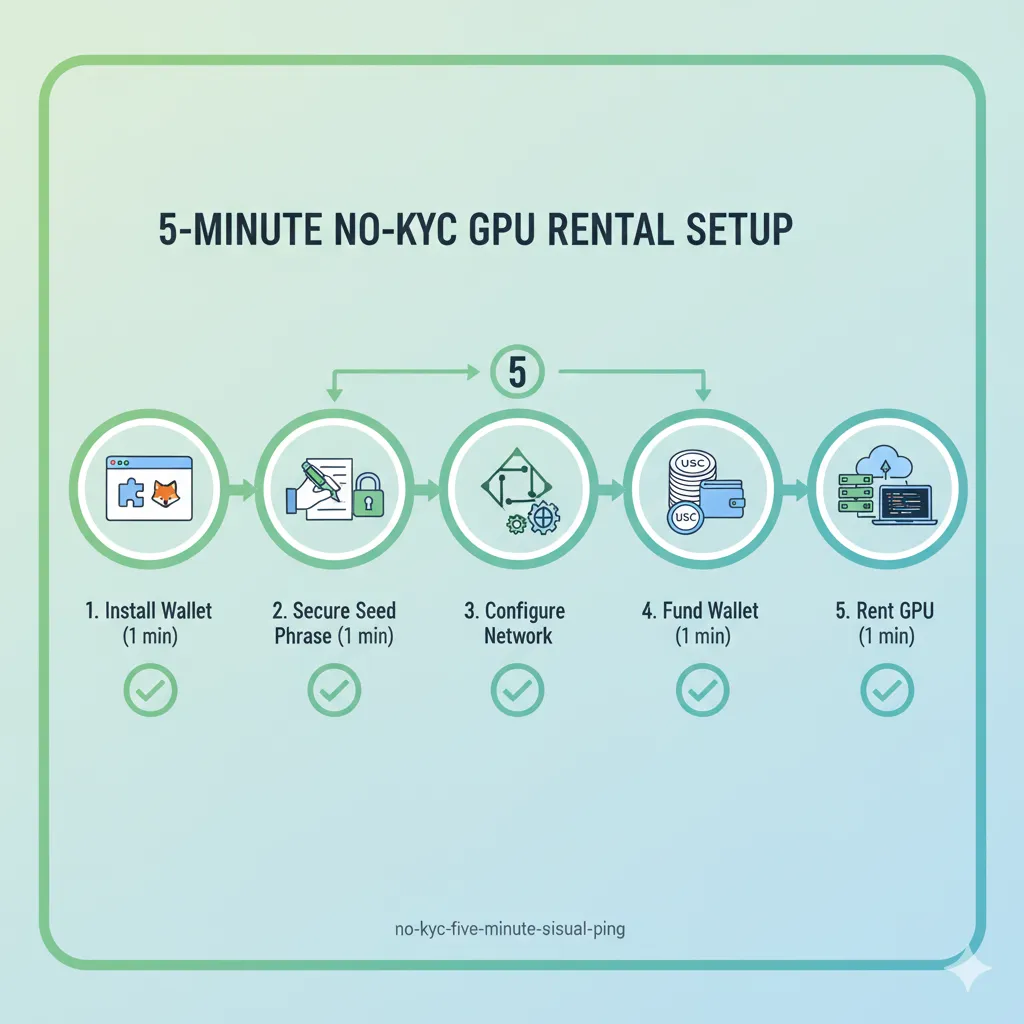
Complete path (starting from zero):
- Install MetaMask (1 minute)
- Secure seed phrase (1 minute)
- Add Polygon network (30 seconds)
- Purchase USDC via onramp (2 minutes)
- Connect to GPUFlow and rent (1 minute)
- Time: Under 5 minutes
The GPU you rent performs identically whether you submitted passport scans or connected a wallet. The compute doesn’t know the difference. But you’ll have access in minutes instead of days, with your identity data remaining yours rather than stored in yet another corporate database.
Related Resources
From this site:
- Complete Guide to Renting GPUs with Cryptocurrency — Full walkthrough including smart contract escrow, security practices, and platform comparisons
- Hidden Fees in GPU Rental: How Crypto Saves International Users Money — Detailed cost analysis showing why cryptocurrency saves money for international users
- GPU Rental Pricing Comparison 2026 — Current pricing across all major platforms
External resources:
- MetaMask Documentation — Official wallet setup and troubleshooting
- Polygon Network — Network information and tools
- GPUFlow Discord — Community support and discussion