RunPod vs Vast.ai: Complete Comparison for AI Developers
Choosing between RunPod and Vast.ai represents one of the most common decisions facing AI developers who need GPU access without enterprise cloud pricing. Both platforms occupy the middle ground between expensive hyperscalers and owning hardware outright, yet they approach the problem differently enough that the right choice depends heavily on your specific circumstances.
This comparison examines both platforms across the dimensions that actually matter for practical GPU rental: pricing structures, reliability characteristics, feature sets, and the workflows each platform handles best. I have used both platforms extensively for training and inference workloads, and this analysis reflects that hands-on experience combined with current market data.
The short version: Vast.ai wins on price, RunPod wins on convenience and reliability. The longer version requires understanding the tradeoffs involved in each platform’s architectural decisions.
What this guide covers:
- Detailed pricing comparison with real-world cost calculations
- Reliability analysis based on platform architecture and user-reported metrics
- Feature-by-feature breakdown of both platforms
- Specific recommendations for different workload types
- Practical guidance for getting started with each platform
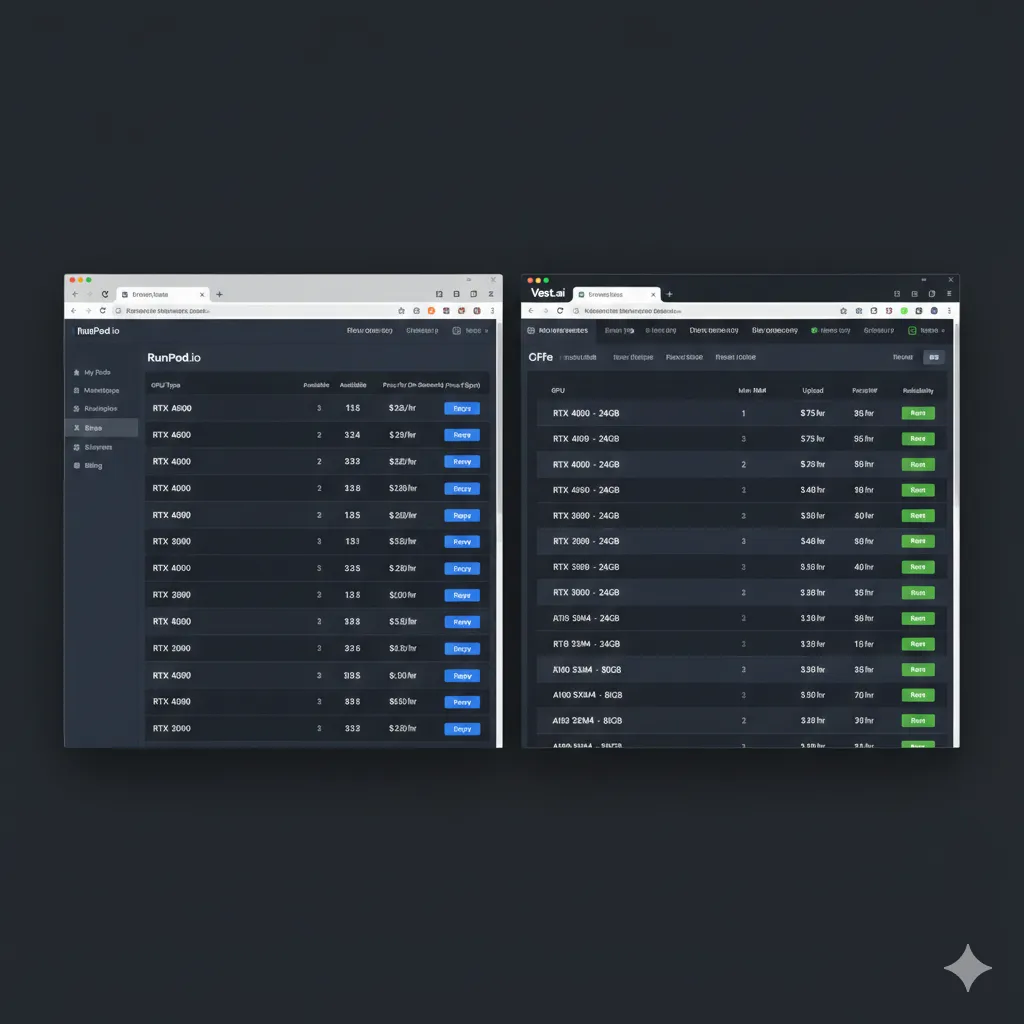
Table of Contents
- Platform Overview
- Pricing Comparison
- Reliability and Uptime
- Available Hardware
- User Experience and Interface
- Templates and Pre-configured Environments
- Storage and Data Transfer
- Payment Options
- Support and Documentation
- Security Considerations
- Real-World Performance Comparison
- Best Use Cases for Each Platform
- Migration Considerations
- Alternatives to Consider
- Frequently Asked Questions
- Final Recommendations
Platform Overview
RunPod: The Managed Marketplace
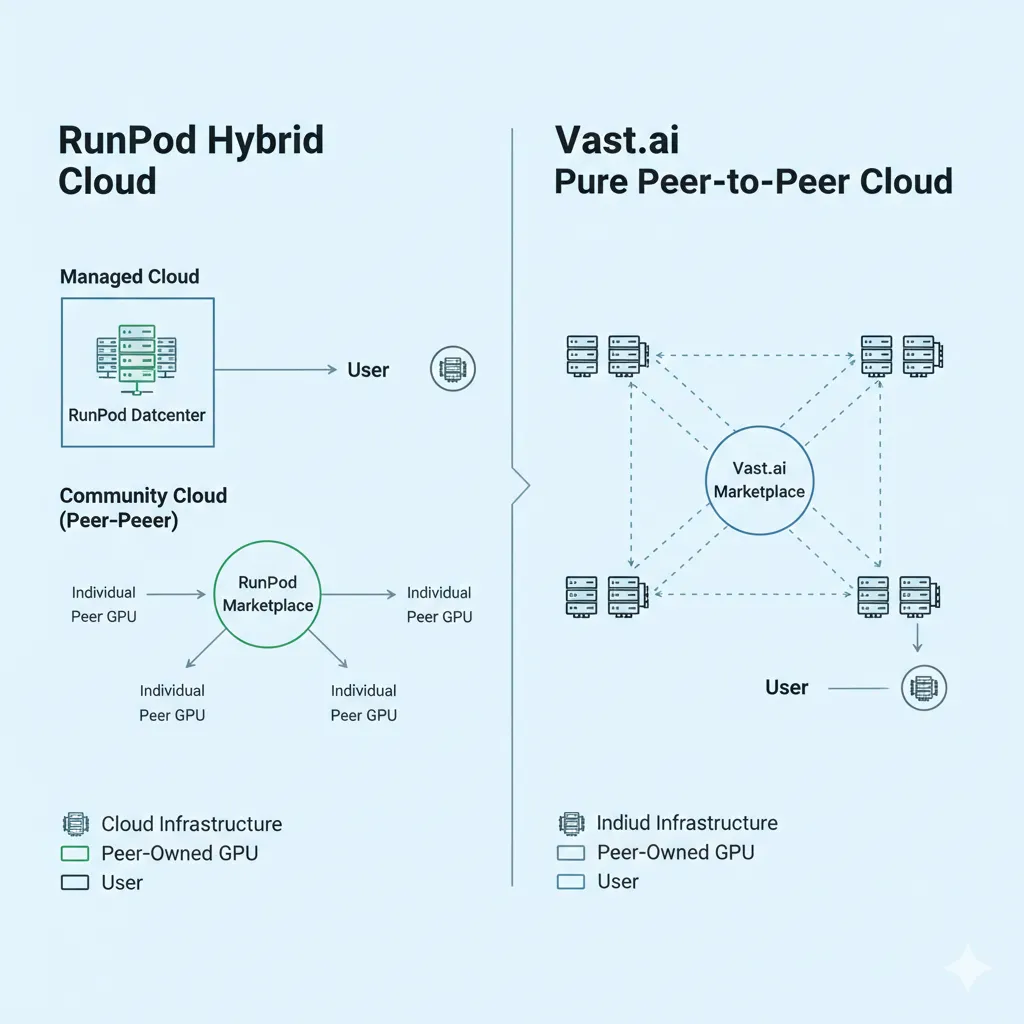
RunPod launched in 2022 with a focus on making GPU rental accessible to individual developers and small teams. The platform operates a hybrid model: a “Secure Cloud” tier with hardware in managed datacenters, and a “Community Cloud” tier that aggregates GPUs from individual providers similar to Vast.ai’s model.
The company has raised venture funding and maintains a full-time engineering and support team. This institutional backing translates into more polished user experience, official templates, and responsive customer service—luxuries that pure peer-to-peer platforms cannot easily provide.
RunPod’s positioning emphasizes ease of use. The platform targets users who want to deploy GPU workloads quickly without deep infrastructure expertise. One-click templates for Stable Diffusion WebUI, text generation inference servers, and Jupyter notebooks reduce setup time from hours to minutes.
RunPod key characteristics:
- Hybrid model combining managed datacenter and community GPUs
- Fixed, predictable pricing on Secure Cloud tier
- Extensive pre-built templates for common AI workloads
- Per-second billing eliminates waste from partial-hour usage
- Active Discord community with responsive official support
- Serverless GPU option for inference workloads
Vast.ai: The Pure Marketplace
Vast.ai pioneered the peer-to-peer GPU rental model when it launched in 2019. The platform connects individual GPU owners—from hobbyists with gaming rigs to operators running small private datacenters—directly with users who need compute resources.
This pure marketplace approach produces the lowest prices in the industry. Without datacenter overhead or managed infrastructure costs, GPU owners can profitably rent hardware at rates that undercut every other option. The tradeoff is variability: different providers offer different levels of reliability, network performance, and hardware quality.
Vast.ai appeals to cost-conscious users comfortable evaluating individual providers based on reliability scores, geographic location, and hardware specifications. The platform provides detailed metrics for each listing, enabling informed decisions about price-reliability tradeoffs.
Vast.ai key characteristics:
- Pure peer-to-peer marketplace with no managed infrastructure
- Auction-style pricing based on supply and demand
- Lowest absolute prices in the GPU rental market
- Detailed provider reliability metrics and ratings
- Wide hardware selection including newest consumer GPUs
- Requires more user sophistication to navigate effectively
Pricing Comparison
Pricing represents the most significant differentiator between these platforms. Both are substantially cheaper than enterprise clouds, but the gap between them is meaningful for budget-constrained projects.
Consumer GPU Pricing
Consumer GPUs like the RTX 4090 and RTX 3090 offer the best price-to-performance for most AI workloads. Neither AWS, Azure, nor GCP offers these GPUs—a major advantage for both RunPod and Vast.ai.
| GPU | RunPod Secure Cloud | RunPod Community | Vast.ai Range | Vast.ai Average |
|---|---|---|---|---|
| RTX 5090 (32GB) | $0.89/hr | $0.55-0.85/hr | $0.38-1.08/hr | $0.65/hr |
| RTX 4090 (24GB) | $0.59/hr | $0.44-0.55/hr | $0.29-0.78/hr | $0.45/hr |
| RTX 3090 (24GB) | $0.46/hr | $0.32-0.40/hr | $0.18-0.60/hr | $0.35/hr |
| RTX A6000 (48GB) | $0.49/hr | $0.40-0.48/hr | $0.40-0.70/hr | $0.52/hr |
Analysis: Vast.ai’s low end beats RunPod’s pricing by 30-50%, but achieving those rates requires selecting providers with lower reliability scores or less convenient locations. At median pricing, the gap narrows to 15-25%.
Datacenter GPU Pricing
For workloads requiring datacenter-class hardware—large language models, multi-GPU training, production inference—both platforms offer A100 and H100 access at substantial discounts compared to hyperscalers.
| GPU | RunPod Secure Cloud | RunPod Community | Vast.ai Range | AWS Equivalent |
|---|---|---|---|---|
| A100 40GB | N/A | $1.09-1.29/hr | $0.80-1.20/hr | ~$4.10/hr |
| A100 80GB | $1.39-1.49/hr | $1.19-1.35/hr | $0.84-1.49/hr | ~$4.10/hr |
| H100 80GB | $2.39/hr | $1.89-2.29/hr | $1.47-2.94/hr | ~$6.90/hr |
| L4 24GB | $0.39/hr | $0.29-0.35/hr | $0.35-0.50/hr | $0.80/hr |
Analysis: Both platforms offer 60-75% savings compared to AWS for datacenter GPUs. The difference between RunPod and Vast.ai narrows for higher-end hardware, where reliability becomes more important and fewer providers exist in the marketplace.
Pricing Model Differences
Beyond raw rates, the pricing models differ in important ways:
RunPod Secure Cloud:
- Fixed pricing regardless of demand
- Guaranteed availability once instance is running
- No bidding or auction dynamics
- Predictable costs for budgeting
RunPod Community Cloud:
- Variable pricing by provider
- Provider sets their own rates
- Can be interrupted if provider needs hardware
- Spot-instance-like economics
Vast.ai:
- Dynamic pricing based on supply and demand
- Providers set minimum prices, market determines actual rates
- Prices can spike during high-demand periods
- Significant savings available during off-peak hours
For a comprehensive analysis of GPU rental pricing across all major providers, including enterprise cloud options, see our complete GPU rental pricing comparison for 2026.
Real Cost Scenario: Training a LoRA Model
To illustrate practical cost differences, consider training a Stable Diffusion LoRA model—a common workload taking approximately 2 hours on an RTX 4090.
| Platform | GPU Selection | Hourly Rate | 2-Hour Total |
|---|---|---|---|
| RunPod Secure | RTX 4090 | $0.59 | $1.18 |
| RunPod Community | RTX 4090 (median) | $0.49 | $0.98 |
| Vast.ai | RTX 4090 (99%+ reliable) | $0.52 | $1.04 |
| Vast.ai | RTX 4090 (97%+ reliable) | $0.38 | $0.76 |
The $0.42 difference between RunPod Secure and the cheapest Vast.ai option adds up over many training runs. At 50 training sessions, that is $21 in savings—meaningful for independent developers but perhaps not worth the reliability uncertainty for professional applications.
For detailed guidance on LoRA training workflows, including GPU selection and cost optimization, see our guide to training Stable Diffusion LoRA models for under $10.
Reliability and Uptime
Reliability separates GPU rental platforms more than any factor except price. An unreliable GPU that costs half as much is no bargain if your training run crashes at hour 11 of a 12-hour job.
RunPod Reliability Architecture
Secure Cloud Tier: RunPod’s Secure Cloud operates hardware in managed datacenters with standardized configurations. The company controls the environment, maintains the hardware, and takes responsibility for uptime. While RunPod does not publish formal SLA numbers for Secure Cloud, user reports and my personal experience suggest 99.5%+ availability.
Hardware in Secure Cloud is dedicated—once you start an instance, it remains available until you terminate it. No provider can reclaim the hardware mid-session.
Community Cloud Tier: Community Cloud reliability varies by provider, similar to Vast.ai. Providers receive reliability ratings based on historical uptime, and users can filter for higher-rated providers. The platform provides some protection through provider vetting, but interruptions can still occur.
Vast.ai Reliability Architecture
Vast.ai is entirely peer-to-peer, meaning reliability depends entirely on individual provider behavior. The platform provides detailed metrics to help users assess risk:
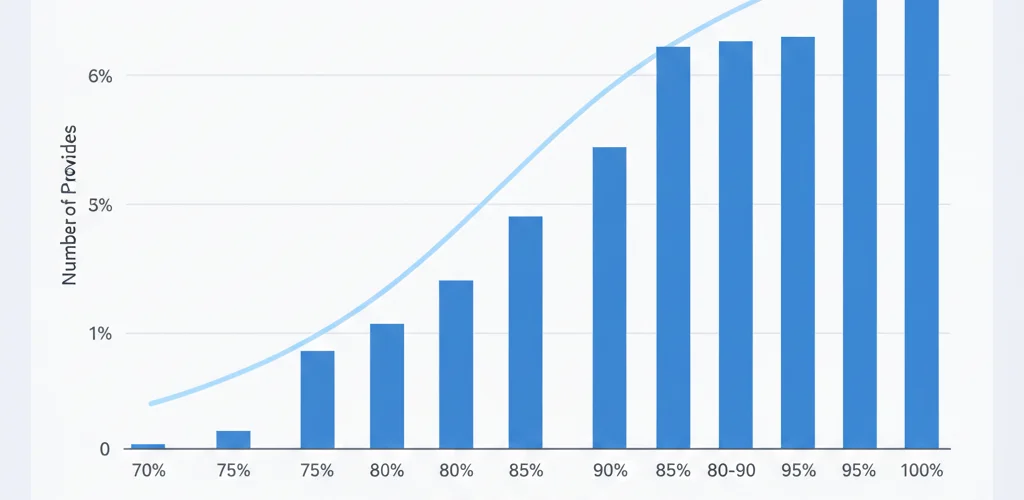
Reliability Score: Percentage of time the machine was available when rented. Ranges from ~92% to 99.9%.
Uptime History: Visual representation of recent availability, showing any outages or interruptions.
Provider Age: How long the provider has been on the platform. Longer track records provide more predictive data.
Number of Rentals: More rentals means more data points for reliability assessment.
Sophisticated users can achieve excellent reliability on Vast.ai by filtering for providers with 99%+ reliability scores, 6+ months platform tenure, and locations in stable power grid regions. However, this filtering reduces the available inventory and often eliminates the cheapest options.
Reliability Comparison Matrix
| Metric | RunPod Secure | RunPod Community | Vast.ai (99%+ filter) | Vast.ai (all) |
|---|---|---|---|---|
| Typical Uptime | 99.5%+ | 98-99% | 99%+ | 95-99% |
| Interruption Risk | Very Low | Moderate | Low | Moderate-High |
| Hardware Consistency | High | Variable | Variable | Variable |
| Network Performance | Consistent | Variable | Variable | Variable |
Practical Reliability Considerations
For training runs under 4 hours: Both platforms provide acceptable reliability. The cost savings from Vast.ai generally outweigh the small risk of interruption for short jobs.
For training runs 4-12 hours: RunPod Secure Cloud or Vast.ai with strict reliability filtering (99%+) makes sense. The consequences of losing 8 hours of training justify paying a premium for reliability.
For training runs over 12 hours: Checkpointing becomes essential regardless of platform. Implement checkpoint saves every 30-60 minutes, and the cost of interruption drops to the time since the last checkpoint rather than the entire run.
For production inference: RunPod Secure Cloud is the clear choice unless you are implementing your own failover and health checking. Production systems require predictable uptime that marketplace variability cannot guarantee.
Available Hardware
Both platforms excel at providing hardware unavailable on enterprise clouds, particularly consumer GPUs. However, their inventories differ in meaningful ways.
Consumer GPU Availability
| GPU Model | RunPod Availability | Vast.ai Availability |
|---|---|---|
| RTX 5090 (32GB) | Good | Moderate (newer GPU) |
| RTX 4090 (24GB) | Excellent | Excellent |
| RTX 4080 (16GB) | Limited | Good |
| RTX 3090 (24GB) | Good | Excellent |
| RTX 3080 (12GB) | Limited | Good |
| RTX 3070 (8GB) | Very Limited | Moderate |
Vast.ai’s larger provider base typically offers more variety in consumer hardware, including older and less common models. RunPod focuses on the most popular choices for AI workloads, prioritizing RTX 4090 and RTX 3090 inventory.
Datacenter GPU Availability
| GPU Model | RunPod Availability | Vast.ai Availability |
|---|---|---|
| H100 80GB | Good | Moderate |
| H200 140GB | Limited | Limited |
| A100 80GB | Excellent | Good |
| A100 40GB | Good (Community) | Good |
| A6000 48GB | Good | Good |
| L4 24GB | Excellent | Good |
| L40S 48GB | Moderate | Limited |
| A40 48GB | Moderate | Moderate |
RunPod has invested in datacenter-class hardware for its Secure Cloud tier, providing consistent availability of A100 and H100 GPUs. Vast.ai’s datacenter GPU availability depends on providers who have purchased or leased this equipment—availability can be sporadic.
Multi-GPU Configurations
For large model training requiring multiple GPUs, both platforms face limitations compared to enterprise clouds.
RunPod: Offers multi-GPU pods up to 8xA100 or 8xH100 in Secure Cloud. Community Cloud multi-GPU availability is limited and inconsistent.
Vast.ai: Multi-GPU systems are available but rare. Finding 4x or 8x GPU systems requires patience and flexibility on timing. Providers with multi-GPU systems command premium rates.
Neither platform matches the multi-GPU availability of AWS p4d instances or Azure ND series. For 8-GPU training at scale, enterprise clouds remain necessary for guaranteed availability.
User Experience and Interface
The user experience gap between RunPod and Vast.ai reflects their different philosophies and target users.
RunPod Interface
RunPod’s interface prioritizes accessibility for users who are not infrastructure experts. The dashboard presents available GPUs with clear pricing, deployment takes a few clicks, and pre-configured templates handle most environment setup.
Strengths:
- Clean, modern interface with intuitive navigation
- Template gallery for common workloads
- One-click deployment for Stable Diffusion, LLM inference, and more
- Integrated JupyterLab access without additional configuration
- Mobile-responsive design for monitoring on the go
Weaknesses:
- Less granular filtering options than Vast.ai
- Community Cloud provider selection less detailed
- Advanced configuration requires digging into settings
Vast.ai Interface
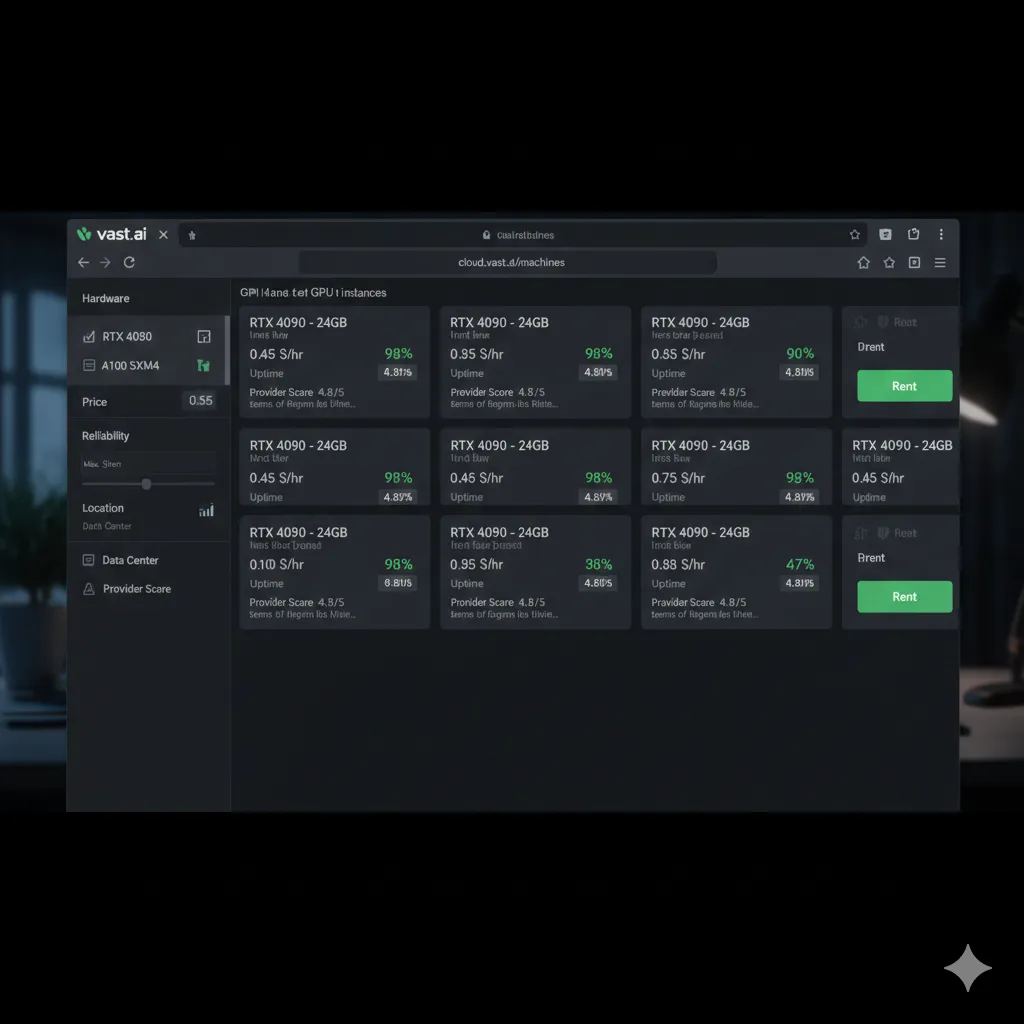
Vast.ai’s interface targets users comfortable with infrastructure decisions. The marketplace view provides extensive filtering and detailed provider information, enabling precise matching of requirements to available hardware.
Strengths:
- Detailed provider metrics (reliability, network speed, location)
- Advanced filtering by GPU memory, disk space, and network bandwidth
- Price sorting and bid-based pricing options
- Transparent provider history and ratings
- CLI tool for programmatic access
Weaknesses:
- Steeper learning curve for new users
- Interface can feel cluttered with information
- Template system less polished than RunPod
- More decisions required before deployment
Instance Management Comparison
| Feature | RunPod | Vast.ai |
|---|---|---|
| Time to First GPU | 2-5 minutes | 2-5 minutes |
| Template Deployment | One-click | Manual or template |
| SSH Access | Yes | Yes |
| Web Terminal | Yes | Yes |
| JupyterLab | Integrated | Manual setup |
| File Browser | Yes | Limited |
| Stop/Resume | Yes | Yes |
| Per-Second Billing | Yes | Yes |
Templates and Pre-configured Environments
Templates dramatically reduce time-to-productivity for common workloads. Both platforms offer template systems, but with different levels of polish and coverage.
RunPod Templates
RunPod maintains official templates for major AI workloads:
Stable Diffusion:
- Automatic1111 WebUI
- ComfyUI
- Forge WebUI
- InvokeAI
LLM Inference:
- Text Generation WebUI (Oobabooga)
- vLLM
- Ollama
- OpenAI-compatible API servers
Development:
- PyTorch with CUDA
- TensorFlow with CUDA
- Jupyter notebooks
- VS Code Server
Other:
- Whisper (speech recognition)
- Music generation models
- Custom container support
These templates include proper CUDA configuration, pre-downloaded models where appropriate, and sensible default settings. A new user can have Stable Diffusion generating images within 10 minutes of creating an account.
Vast.ai Templates
Vast.ai’s template system is less curated but more flexible:
Official Templates:
- Basic CUDA development environments
- Jupyter notebook configurations
- Common ML framework setups
Community Templates:
- User-submitted configurations
- Variable quality and maintenance
- Wide variety but inconsistent documentation
Docker Integration:
- Full Docker image support
- Pull any public image
- Build custom images
Vast.ai’s Docker-native approach provides maximum flexibility for users who know exactly what they want. However, the lack of maintained official templates means more setup work for common use cases.
Template Comparison
| Workload | RunPod | Vast.ai |
|---|---|---|
| Stable Diffusion | One-click, multiple UIs | Manual or community |
| LLM Inference | Multiple options, one-click | Manual setup |
| Training (PyTorch) | Template available | Template available |
| Custom Containers | Supported | Excellent support |
| Setup Time (common workloads) | 5-10 minutes | 15-30 minutes |
For users running standard AI workloads, RunPod’s template advantage saves meaningful time. For users with custom requirements or Docker expertise, Vast.ai’s flexibility may be preferable.
Storage and Data Transfer
Storage and data transfer considerations often surprise new users. GPU costs are obvious; ancillary costs for storing datasets and moving data are less visible but can be significant.
RunPod Storage
Pod Storage:
- Each pod includes configurable disk space
- Container storage persists while pod exists
- Pricing included in pod hourly rate up to a threshold
- Additional storage billed separately
Network Volume Storage:
- Persistent storage that survives pod termination
- $0.07 per GB per month
- Can be attached to pods in the same region
- Useful for datasets and model weights
Data Transfer:
- No additional charges for data transfer
- Download speeds vary by datacenter
- Upload speeds generally excellent
Vast.ai Storage
Instance Storage:
- Disk space determined by provider
- Varies widely between providers
- Some providers offer limited SSD; others have terabytes available
- Storage is part of hourly rate
Persistent Storage:
- No native persistent storage product
- Users must manage their own solutions
- Common approaches: cloud storage sync, external servers
- More complex than RunPod for datasets that span multiple sessions
Data Transfer:
- No platform charges for transfer
- Network speeds vary dramatically by provider
- Key metric to check when selecting providers
- Some providers have limited bandwidth
Storage Cost Comparison
For a typical workflow requiring 100GB of persistent storage:
| Storage Need | RunPod | Vast.ai |
|---|---|---|
| Dataset Storage (100GB, 1 month) | $7.00 | External solution required |
| Model Weights (50GB, included in pod) | $0 | $0 |
| Data Transfer | Free | Free |
RunPod’s Network Volume feature provides significant convenience for users who need data persistence across sessions. Vast.ai users typically sync to cloud storage (S3, GCS, or similar) between sessions, adding complexity and potential transfer time.
Payment Options
Payment flexibility matters for international users, those avoiding traditional banking, and organizations with specific procurement requirements.
RunPod Payment Methods
- Credit and debit cards (Visa, Mastercard, American Express)
- Cryptocurrency (Bitcoin, Ethereum, USDC)
- Prepaid account credits
- No invoicing for enterprise accounts (self-serve only)
RunPod’s cryptocurrency option is notable—many cloud platforms avoid crypto payments entirely. The implementation is straightforward: deposit crypto, receive account credits, use credits for GPU rental.
Vast.ai Payment Methods
- Credit and debit cards
- Prepaid account credits
- No cryptocurrency support
- No invoicing
Vast.ai’s more limited payment options may affect users who prefer cryptocurrency or require formal invoicing for business accounting.
Account Requirements
| Requirement | RunPod | Vast.ai |
|---|---|---|
| Email Verification | Yes | Yes |
| Phone Verification | No | No |
| Identity Verification (KYC) | No | No |
| Business Verification | No | No |
| Minimum Deposit | None | None |
Both platforms maintain low barriers to entry. Neither requires the extensive verification that enterprise cloud providers mandate. This accessibility comes with tradeoffs—neither platform will provide the compliance documentation that large organizations may require.
Support and Documentation
When things go wrong—and they will eventually—support quality determines how quickly you recover.
RunPod Support
Channels:
- Discord community (very active)
- Email support
- Documentation wiki
- Video tutorials
Response Time:
- Discord: Often minutes during business hours
- Email: Typically 24-48 hours
- Community questions: Often answered by staff directly
RunPod’s Discord presence is exceptional for a company this size. Staff members actively monitor channels and frequently respond to user questions. The company has clearly invested in community building as a support strategy.
Documentation covers common workflows well but can lag behind new features. Video tutorials help visual learners but are not comprehensive.
Vast.ai Support
Channels:
- Discord community
- Email support
- Documentation
- FAQ
Response Time:
- Discord: Variable, often community-answered
- Email: 24-72 hours typical
- Less staff presence in community channels
Vast.ai’s support reflects its marketplace nature. The company mediates between renters and providers but has less control over the infrastructure and therefore less ability to resolve certain issues. Provider-side problems require working with individual providers.
Documentation is adequate for basic operations but less detailed than RunPod’s for specific workloads.
Support Comparison
| Aspect | RunPod | Vast.ai |
|---|---|---|
| Community Activity | Very High | Moderate |
| Staff Response | Frequent | Occasional |
| Documentation Depth | Good | Adequate |
| Video Content | Yes | Limited |
| Self-Service Resolution | High | Moderate |
Security Considerations
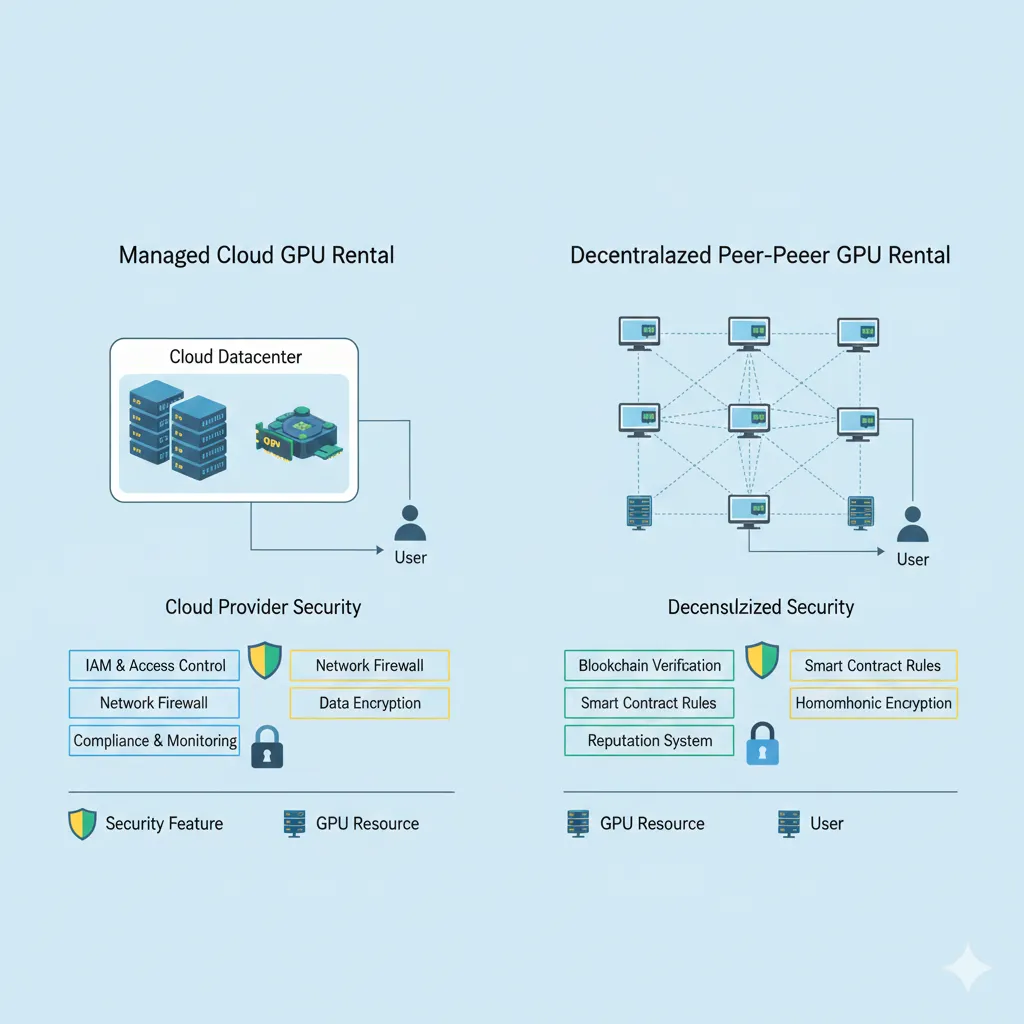
Security concerns differ between managed platforms and peer-to-peer marketplaces. Understanding the threat model helps make appropriate choices.
RunPod Security Model
Secure Cloud:
- Hardware in managed datacenters
- Standard datacenter physical security
- RunPod controls the infrastructure stack
- Container isolation between users
- No access to bare metal by renters
Community Cloud:
- Hardware controlled by providers
- Provider has physical access to hardware
- Potential for malicious providers (rare but possible)
- Container isolation but not guaranteed
Vast.ai Security Model
- All hardware controlled by individual providers
- Provider has physical and administrative access
- Detailed provider vetting but not foolproof
- Container isolation varies by provider configuration
- Some providers may log or inspect traffic
Practical Security Recommendations
For sensitive workloads (proprietary models, confidential data):
- Use RunPod Secure Cloud exclusively
- Consider enterprise cloud if compliance is required
- Never use peer-to-peer marketplace GPUs for sensitive data
For non-sensitive workloads (public models, synthetic data):
- Both platforms are acceptable
- Providers with long track records and high ratings present low risk
- Standard security hygiene applies (no hardcoded credentials, etc.)
For any workload:
- Avoid leaving credentials in training scripts
- Use environment variables for API keys
- Clean instances before terminating
- Assume providers might inspect disk contents after termination
Real-World Performance Comparison
Raw pricing and features only matter if the GPUs actually perform as expected. I ran identical workloads on both platforms to measure practical differences.
Test Methodology
Hardware: RTX 4090 24GB Workload 1: Stable Diffusion XL image generation (50 images, 30 steps each) Workload 2: LoRA training (50 images, 10 epochs) Workload 3: LLM inference (Llama 2 7B, 1000 tokens generated)
Each test ran three times on each platform, selecting mid-range providers on Vast.ai (98%+ reliability, median pricing).
Performance Results
| Workload | RunPod Secure | Vast.ai (98%+ provider) | Difference |
|---|---|---|---|
| SDXL Generation (50 images) | 4m 32s | 4m 28s | -1.5% |
| LoRA Training (10 epochs) | 52m 14s | 53m 41s | +2.7% |
| LLM Inference (1000 tokens) | 28s | 29s | +3.6% |
Analysis: Performance differences are negligible for compute-bound workloads. The RTX 4090 is the same GPU on both platforms—the silicon does not care who owns it.
Slight Vast.ai slowdown in training and inference likely reflects network overhead rather than GPU performance. These differences are well within noise for practical purposes.
Network Performance
Network performance varies more significantly:
| Metric | RunPod Secure | Vast.ai Average | Vast.ai Best |
|---|---|---|---|
| Download Speed | 500+ Mbps | 200-400 Mbps | 800+ Mbps |
| Upload Speed | 400+ Mbps | 150-300 Mbps | 600+ Mbps |
| Latency Consistency | High | Variable | High |
For workloads involving significant data transfer (large datasets, frequent model uploads), RunPod’s consistent network performance provides meaningful time savings. For compute-dominant workloads, network differences matter less.
Best Use Cases for Each Platform
Based on pricing, reliability, and feature analysis, here are specific recommendations for common scenarios.
Choose RunPod Secure Cloud When:
Production inference systems: The reliability requirements of production systems justify RunPod’s premium. A crashed inference server at 2 AM is worth more than the cost difference.
Time-sensitive training runs: When deadlines matter, predictable availability beats hoping a Vast.ai provider does not go offline. The modest cost increase is insurance against wasted time.
New users learning the space: RunPod’s templates and documentation reduce the learning curve. Start here, then consider Vast.ai once you understand your needs.
Teams with shared resources: RunPod’s organization features and persistent storage make collaboration easier than coordinating across Vast.ai providers.
Choose Vast.ai When:
Budget-constrained exploration: When learning or experimenting, Vast.ai’s 30-40% cost savings enable more iterations within a fixed budget. Interrupted runs matter less during exploration.
Batch processing with checkpointing: Workloads that checkpoint regularly can tolerate provider interruptions. The cost savings compound over long training runs with proper checkpoint strategy.
Unusual hardware requirements: Need a specific older GPU? Vast.ai’s diverse provider base includes hardware RunPod does not stock.
Overnight or weekend training: Off-peak pricing on Vast.ai drops significantly. Launching long training runs Friday evening at reduced rates makes sense if you can tolerate the reliability uncertainty.
Use Cases Where Either Works:
LoRA training (2-4 hours): Both platforms handle this workload well. Choose based on current pricing and availability.
Stable Diffusion generation: Interactive generation sessions work fine on either platform. The reliability risk during a 1-hour session is minimal.
One-off experiments: Quick tests to validate ideas before committing to longer runs work equally well on both platforms.
Migration Considerations
Switching between platforms is straightforward given some preparation. Both use standard container technologies and SSH access.
Data Migration
Datasets and model weights:
- Store in cloud storage (S3, GCS, Backblaze B2) accessible from either platform
- Avoid relying on platform-specific persistent storage
- Download from cloud to instance at session start
Code and configurations:
- Use git repositories for all code
- Store configuration files in version control
- Avoid platform-specific paths in scripts
Container images:
- Both platforms support Docker Hub and container registries
- Custom images work on both platforms
- Abstract platform differences in entrypoint scripts
Workflow Portability
A portable workflow works on either platform with minimal changes:
# Example portable setup script
#!/bin/bash

# Clone code repository
git clone https://github.com/yourrepo/training-code.git

# Download dataset from cloud storage
aws s3 sync s3://your-bucket/dataset ./dataset

# Download model weights
wget https://huggingface.co/model/weights.safetensors -O ./models/

# Run training
python train.py --config ./config.yaml

# Upload results
aws s3 sync ./output s3://your-bucket/results/
This script runs identically on RunPod or Vast.ai, requiring only appropriate credentials for cloud storage access.
Alternatives to Consider
While RunPod and Vast.ai dominate the marketplace GPU rental space, other options merit consideration depending on your requirements.
Lambda Labs
Lambda Labs offers managed GPU cloud with fixed pricing and strong ML focus. Pricing falls between enterprise clouds and marketplaces. Good choice for users wanting reliability without marketplace complexity and willing to pay a moderate premium.
GPUFlow
GPUFlow operates a peer-to-peer marketplace with blockchain-based payment processing. Smart contracts handle escrow, eliminating counterparty risk without central authority. Primary advantages: cryptocurrency payments without KYC, lower platform fees (10-15% versus 20-30%), and rapid instance provisioning. Worth considering for users who prefer decentralized infrastructure.
Enterprise Clouds (AWS, Azure, GCP)
For compliance requirements, guaranteed SLAs, and enterprise support, hyperscalers remain necessary. The 3-5x price premium buys capabilities marketplace platforms cannot provide: SOC2 certification, HIPAA compliance, dedicated support engineers, and contractual uptime guarantees.
Hardware Purchase
At sufficient scale, owning hardware becomes economical. Break-even typically occurs around 2,500-3,000 hours of usage for consumer GPUs. Organizations running continuous workloads should evaluate total cost of ownership against rental.
Frequently Asked Questions
Is RunPod or Vast.ai cheaper for GPU rental?
Vast.ai typically offers lower hourly rates due to its pure peer-to-peer marketplace model. RTX 4090 GPUs on Vast.ai range from $0.29 to $0.78 per hour, while RunPod’s Secure Cloud tier charges $0.59 per hour for the same GPU. However, achieving Vast.ai’s lowest rates requires selecting providers with lower reliability scores. At equivalent reliability levels (99%+), the price gap narrows to 15-25%.
Which platform is more reliable for production workloads?
RunPod’s Secure Cloud tier provides more consistent reliability with curated datacenter hardware. The company controls the infrastructure and takes responsibility for uptime. Vast.ai reliability varies by individual provider, with ratings ranging from 97% to 99.9%. For production inference requiring high uptime, RunPod is the safer choice. For batch training jobs that can tolerate occasional interruption, Vast.ai offers better economics.
Can I use consumer GPUs like RTX 4090 on both platforms?
Yes. Both RunPod and Vast.ai offer access to consumer GPUs including RTX 3090, RTX 4090, and RTX 5090. This distinguishes them from enterprise cloud providers like AWS, Azure, and GCP, which only offer datacenter GPU models (A100, H100, etc.). Consumer GPUs provide excellent price-to-performance for most AI workloads.
Which platform has better pre-configured templates for AI workloads?
RunPod offers more extensive official templates, including one-click deployments for Stable Diffusion (multiple UIs), various LLM inference servers, and popular training frameworks. Templates are maintained by RunPod staff and include proper CUDA configuration. Vast.ai provides community templates but with less curation and variable maintenance. Users who prefer turnkey setups typically find RunPod more convenient.
Do RunPod and Vast.ai require identity verification?
Neither platform requires full KYC verification for basic usage. RunPod requires email verification and a valid payment method. Vast.ai requires minimal account information. Both platforms are significantly less restrictive than enterprise cloud providers, which mandate business verification, credit checks, and sometimes quota approval processes before granting GPU access.
How do I choose between the platforms for a specific project?
Consider three factors: reliability requirements, budget constraints, and setup time value. Production systems or deadline-critical training runs favor RunPod Secure Cloud. Exploratory work or budget-constrained projects favor Vast.ai. New users benefit from RunPod’s templates. Experienced users with custom requirements may prefer Vast.ai’s flexibility.
Can I switch between platforms easily?
Yes. Both platforms use standard SSH access and support Docker containers. Storing datasets in cloud storage and code in git repositories enables easy migration. The main switching cost is learning each platform’s interface and provisioning workflows—typically a few hours of familiarization.
Final Recommendations
After extensive use of both platforms, my recommendations are:
Start with RunPod if:
- You are new to GPU rental
- You need production reliability
- Template availability matters to your workflow
- You value responsive support
Start with Vast.ai if:
- Cost optimization is your primary concern
- You have infrastructure experience
- Your workloads tolerate interruption
- You enjoy evaluating options and optimizing
Consider GPUFlow if:
- You prefer cryptocurrency payments
- KYC requirements are a concern
- Lower platform fees impact your economics
- You want blockchain-verified payment security
The good news: both RunPod and Vast.ai provide excellent value compared to enterprise alternatives. Either choice saves 60-80% compared to AWS or Azure. The differences between them, while meaningful, are secondary to the massive savings both enable.
For ongoing projects, I recommend maintaining accounts on both platforms. Use RunPod for reliability-critical work and time-sensitive projects. Use Vast.ai for exploration, experiments, and batch processing where cost matters more than guaranteed availability. The flexibility to choose based on project requirements, rather than committing entirely to one platform, maximizes both cost efficiency and reliability where each matters most.
Looking for GPU rental with cryptocurrency payments and smart contract security? GPUFlow offers competitive marketplace rates with blockchain-verified escrow, lower platform fees, and no KYC requirements. Check current availability and pricing at gpuflow.app.
Related guides:
- GPU Rental Pricing Comparison 2026
- How to Train Stable Diffusion LoRA Models for Under $10
- Complete Guide to Renting GPUs with Cryptocurrency
This comparison was last updated February 12, 2026. Platform features and pricing change frequently. Verify current information directly with RunPod and Vast.ai before making decisions.